
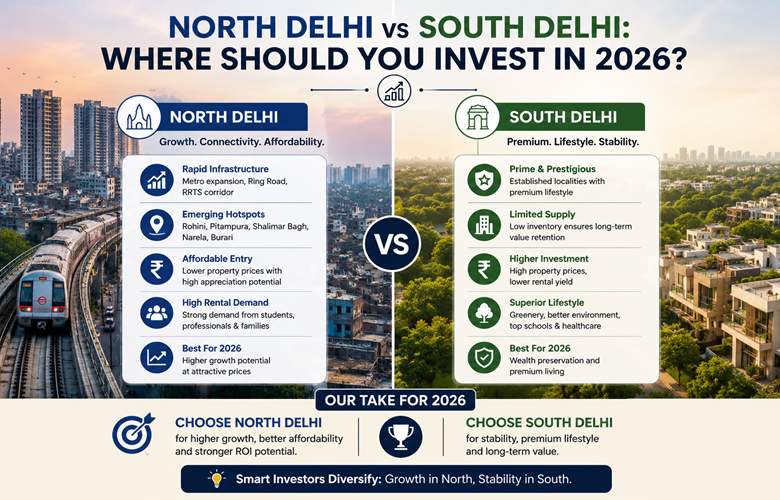
North Delhi vs South Delhi: Where Should You Actually Invest in 2026?
For prestige, liquidity and a proven track record, South Delhi wins; average apartment asking prices there run near ₹23,000–24,700 per sq. ft. For entry price and new-supply scarcity, North Delhi wins, with Kamla Nagar builder floors around ₹10,300 per sq. ft. and its first gated high-rise in decades now arriving.
- South Delhi apartments ask ₹23,000-24,700 per sq. ft. North Delhi averages ₹11,700 per sq. ft. and Kamla Nagar is about ₹10,300 per sq. ft. (Square Yards, 99acres).
- Delhi’s prime residential market rose 6.9% in 2025 (Knight Frank), and Delhi-NCR led all top-seven cities on headline price growth (ANAROCK).
- South Delhi’s edge is prestige, deep resale liquidity, and proven appreciation. The catch: almost no new gated high-rise supply and a heavy entry ticket.
- North Delhi’s edge is a lower entry price and a real supply gap its first institutional gated high-rise in over 30 years is now taking shape on the old Birla Cotton Mills site.
- Where you should invest depends on your goal: buy South Delhi for the address, buy North Delhi for the entry point before the product exists.
Ask ten people whether to invest in North Delhi vs South Delhi, and you will hear the same reflex: South is posh; North is for students. It is a tidy line. It is also two years out of date.
The 2026 numbers point to a different question. South Delhi has hit a price ceiling with very little new gated supply left to buy. North Delhi, long a builder-floor market, is about to get its first institutional gated high-rise in more than three decades. So the honest comparison is not about which half of the city is nicer. It is about where the gap between price and value is still open.
North Delhi vs South Delhi: the snapshot
- South Delhi apartment asking prices average ₹23,000-24,700 per sq. ft. ultra-prime pockets like Golf Links and Moti Bagh cross ₹44,000 per sq. ft. (Square Yards, Dec 2025).
- North Delhi’s average apartment ask is roughly ₹11,700 per sq. ft. Kamla Nagar builder floors trade between ₹5,150 and ₹12,050 per sq. ft.
- Delhi-NCR posted the sharpest 2025 price jump among India’s top seven cities, up about 23% year-on-year to nearly ₹9,300 per sq. ft. on average (ANAROCK).
- Delhi’s prime residential segment appreciated 6.9% in 2025, lifting the city to 17th on Knight Frank’s global PIRI 100 index.
- The Kamla Nagar-Model Town-Civil Lines belt has not seen a new gated luxury high-rise in over 30 years; that supply gap is the core of the North Delhi case.
- Delhi residential rental yields sit in a 2-4% band, with South Delhi’s Maharani Bagh, South Extension II and Hauz Khas among the stronger rent-return pockets (99acres, NoBroker).
The North Delhi vs South Delhi comparison, in one table
Most comparisons stop at the cliché. This one starts with the price ceiling and the supply gap, because that is what actually moves an investment decision. Here is the side-by-side.
| Factor | North Delhi | South Delhi |
|---|---|---|
| Avg apartment ask (per sq. ft. ) | ₹11,700; Kamla Nagar ₹10,300 | ₹23,000-24,700 |
| Typical product | Builder floors, older flats; one new gated high-rise arriving | Builder floors, independent luxury floors, limited gated stock |
| Entry ticket (3 BHK) | Lower; room below the South Delhi floor | High; premium pockets start above ₹13,000/sq. ft. |
| New gated high-rise supply | First in 30+ years (Kamla Nagar belt) | Thin; mostly resale and redevelopment |
| Tenant profile | Students, faculty, PG demand (DU North Campus) | HNI, corporate and expat families |
| Rental yield | 2-4% | 2-4%, often lower on ultra-prime |
| Best-fit buyer | Entry-point and early-mover investors | Prestige, liquidity and legacy buyers |
Read that table one more time down the middle column. The story is not that North Delhi is cheaper. It is that North Delhi is cheaper and finally has a product worth buying.
Entry price: what your first cheque actually buys
The gap between the two zones is wide. South Delhi apartments ask around ₹23,000 to ₹24,700 per sq. ft. on average, and the truly prime pockets are far higher. Golf Links, Moti Bagh and Rama Krishna Puram have crossed ₹44,000 per sq. ft. (Square Yards, December 2025). North Delhi’s average apartment ask is closer to ₹11,700 per sq. ft. and Kamla Nagar’s resale builder floors trade between roughly ₹5,150 and ₹12,050 per sq. ft. (99acres).
That is a two-to-one gap at the average.
For a buyer writing a first cheque, that difference decides everything downstream: loan size, stamp duty, and how much appreciation you need just to break even. Delhi levies a stamp duty of 6% for men, 4% for women, and 5% for joint owners, plus a 1% registration fee (Delhi Revenue Department). On a ₹5 crore South Delhi floor, that is ₹25-35 lakh in duty and registration before you own a single brick.
One caution on any per sq. ft. figure you see. In India, RERA makes carpet area the legal standard, but many resale builder-floor quotes still use loose super or plot-linked areas. Always confirm which area a price is quoted on before you compare North against South. Our Conscient Hines Elevate Kamla Nagar walks through how to read those numbers on a new launch.
Supply and product: builder floors versus a new gated high-rise
This is the real divergence, and it is where the generic comparisons go quiet.
South Delhi is largely built out. Its luxury supply is dominated by independent floors and redevelopments, not by new gated towers. Knight Frank noted that NCR sales fell about 9% in 2025, partly because well-located, ready inventory in the segments buyers actually want has thinned. When supply is tight and the address is settled, you pay for scarcity at the top of the band.
North Delhi’s Kamla Nagar belt has a different kind of scarcity. It is an established, high-footfall address that has not seen a new gated luxury high-rise in more than thirty years. Buyers who wanted a modern, amenity-led tower here simply had no product to buy. That is now changing, which is why the redevelopment of the former Birla Cotton Mills matters.
The 9.82-acre parcel in Kamla Nagar is being developed by a Conscient–Hines-led group into North Delhi’s first institutional gated high-rise in decades: 3 and 4 BHK apartments, a low-density plan of roughly two homes per floor, and a 100+ amenity clubhouse, sitting opposite a 15-acre DDA park. Indicative pricing has been quoted at around ₹28,000 per sq. ft. All-inclusive, though the project is pre-RERA and that figure must be confirmed at the registered launch. The early-buyer price case sets out what that pre-launch entry point could mean.
In South Delhi, you are buying a finished story. In North Delhi’s Kamla Nagar, for the first time in a generation, you can buy the address before the product exists, and that window closes the day the first tower sells out.
Appreciation and rental income: proven versus emerging
Both zones sit inside a strong Delhi macro. The city’s prime residential prices rose 6.9% in 2025 (Knight Frank Wealth Report 2026), and Delhi-NCR led all seven major Indian cities on headline price growth, up about 23% year-on-year to nearly ₹9,300 per sq. ft. on average (ANAROCK). A February-March 2026 Reuters analyst poll expects Delhi-NCR home prices to rise 5-7% a year over the next 3 years.
The macro is not the deciding factor. The entry point is.
Here is the mechanic, in plain terms:
- South Delhi appreciation is proven but works off a high base. A ₹24,000 per sq. ft. Floor rising 6% adds roughly ₹1,440 per sq. ft. a year, real money, but on an already expensive asset.
- North Delhi’s early-mover case is about the base itself re-rating. When a settled address gets its first gated high-rise, the reference price for the whole micro-market can shift, not just track inflation.
- Rental income favours South Delhi in absolute rupees. Maharani Bagh, South Extension II, Malviya Nagar, and Hauz Khas rank among the city’s stronger rent-return pockets, while Kamla Nagar runs on dependable student and faculty demand from Delhi University’s North Campus, with rents commonly between ₹10,000 and ₹38,000 a month.
Both zones yield in the same 2-4% band, so rental yield alone rarely settles the decision. Capital strategy does.
Connectivity, lifestyle, and the risk column
South Delhi offers the lifestyle most buyers picture: leafy colonies, established schools, embassies, and marquee retail. North Delhi offers something more urban and central, Delhi University, historic markets, and an address inside the old city rather than out on its edge. Kamla Nagar sits about 1.5 km from Vishwavidyalaya Metro and 2.8 km from GTB Nagar Metro, with Civil Lines and Hindu Rao Hospital a short drive away.
Now, the risk column, stated honestly:
- South Delhi’s risk is price. You are buying at or near the ceiling, so your margin for error is thin, and entry costs are high.
- North Delhi’s risk is execution and timing. A pre-launch, pre-RERA project carries delivery and approval risk, and indicative pricing can change. The upside exists precisely because the product has not yet been proven.
That trade is the whole decision. Certainty costs more; opportunity carries risk.
The verdict: who should pick North, who should pick South
There is no universal winner in North Delhi vs South Delhi. There is only a fit for your goal.
- Pick South Delhi if you want a settled prestige address, deep resale liquidity, and appreciation you can underwrite from years of data, and you can absorb a ₹13,000-44,000 per sq. ft. entry.
- Pick North Delhi if you want a lower entry price, a central location, and a rare first-mover position in a micro-market getting its first gated high-rise in a generation and you are comfortable with pre-launch risk.
For investors specifically, the sharper question is not which zone is nicer. It is where the gap between price and value is wider. South Delhi’s gap is mostly closed. North Delhi, for now, is not. If you want to see how Kamla Nagar stacks up against the other launches competing for the same rupee, our North and West Delhi luxury comparison goes deeper.
What we are seeing on the ground in Kamla Nagar
We field the same question most weeks from buyers weighing North against South Delhi, and the pattern has shifted over the last two quarters. Buyers who once treated North Delhi purely as a student-housing rental play now ask about it as a primary residence and a capital-appreciation bet. The trigger is supply. For thirty years, anyone who wanted a modern gated tower in the Kamla Nagar belt had to look to Gurugram or Noida. That is no longer true.
One recent inquiry captures it. A Delhi-based professional family had been comparing a ₹5.5 crore builder floor in a South Delhi colony against the pre-launch pricing at the former Birla Cotton Mills site. Their reasoning was not about prestige. It was about what the same budget buys: an ageing independent floor at the top of its price band, or a new low-density apartment with a clubhouse and park frontage in a central address that has never offered this product before. They wanted the newer asset in the older neighbourhood.
That is the honest tension in this comparison. South Delhi is the safer, more liquid choice, and we say so plainly. But the opportunity, the chance to enter an established address before its first modern tower sets the new reference price in the North right now.
The buyers moving fastest aren’t chasing the cheapest square foot. They are chasing the last address in central Delhi where the price hasn’t caught up to the product yet.
Key takeaways
The North Delhi vs South Delhi choice comes down to one trade-off: certainty versus entry point.
- South Delhi wins on prestige, resale depth and proven appreciation, but you enter at ₹23,000-44,000 per sq. ft. near the ceiling.
- North Delhi wins on entry price, Kamla Nagar near ₹10,300 per sq. ft., and on a supply gap South Delhi does not have.
- Both zones are inside a strong Delhi macro, with 6.9% prime price growth in 2025, so the entry point, not the city trend, drives your return.
- For first-mover investors, North Delhi’s Kamla Nagar belt offers its first gated high-rise in a generation on the former Birla Cotton Mills site.
If that first-mover window fits your risk appetite, the Conscient Hines Elevate Kamla Nagar buyer guide is the next thing worth reading.
Frequently asked questions
Is North Delhi or South Delhi better for investment in 2026?
It depends on your goal. South Delhi suits prestige, resale liquidity and proven appreciation, but you enter near a price ceiling of ₹23,000 to ₹24,700 per sq. ft. North Delhi suits lower entry pricing, a central address and first-mover exposure to new gated supply, with more delivery and timing risk to accept.
What is the price difference between North Delhi and South Delhi property?
The gap is roughly two-to-one on average. South Delhi apartments ask around ₹23,000 to ₹24,700 per sq. ft. While North Delhi averages near ₹11,700 per sq. ft. and Kamla Nagar is around ₹10,300 per sq. ft. Ultra-prime South Delhi pockets such as Golf Links cross ₹44,000 per sq. ft.
Why are property prices in North Delhi lower than in South Delhi?
North Delhi’s stock is mostly older builder floors and DDA apartments rather than new gated towers, and its address carries a student-and-market character rather than an elite-colony one. South Delhi commands a premium for leafy planned colonies, embassy zones, and decades of proven appreciation. That perception gap, plus product age, keeps North Delhi’s rates lower.
Which Delhi area has a better rental yield, North or South?
Both are in Delhi’s usual 2 to 4 percent yield band, so neither wins decisively on yield alone. South Delhi commands higher rents in absolute rupees, with Maharani Bagh, South Extension II, and Hauz Khas among the stronger pockets. North Delhi’s Kamla Nagar thrives on steady demand from students and faculty near Delhi University’s North Campus.
Is Kamla Nagar a good place to invest in 2026?
Kamla Nagar offers a central North Delhi address at roughly ₹10,300 per sq. ft. With reliable student rental demand from Delhi University. Its 2026 investment case rests on new supply: the former Birla Cotton Mills site is bringing the belt’s first gated high-rise in over thirty years. Verify all launch pricing at the RERA-registered stage.
How much are stamp duty and registration charges in Delhi?
In most of Delhi, stamp duty is 6 percent for men, 4 percent for women, and 5 percent for joint owners, plus a 1 percent registration fee on the property value. NDMC and Cantonment areas carry different rates. On a ₹5 crore purchase, expect roughly ₹25 to ₹35 lakh before you own it.
Does South Delhi or North Delhi have more new luxury projects?
South Delhi has more luxury inventory overall, but most of it is independent floors and redevelopment, not fresh gated towers. North Delhi has almost none historically, which is why the incoming Conscient Hines Elevate Kamla Nagar matters: it is the belt’s first institutional gated high-rise in more than thirty years, entering a genuine supply gap.
Will North Delhi property prices rise faster than South Delhi?
Possibly, because North Delhi works off a lower base. When a settled address receives its first gated high-rise, the reference price for the whole micro-market can re-rate, not just track inflation. South Delhi appreciates from an already high base, so gains are steadier, but percentage gains are harder to achieve. Neither outcome is guaranteed.
Should an NRI buy in North Delhi or South Delhi?
NRIs can buy residential property in either zone under RBI’s FEMA rules, funding through NRE or NRO accounts. South Delhi suits NRIs wanting a trophy address and easy resale. North Delhi suits those seeking a lower entry and first-mover upside. Check current RERA registration and repatriation limits before you commit funds from abroad.
