
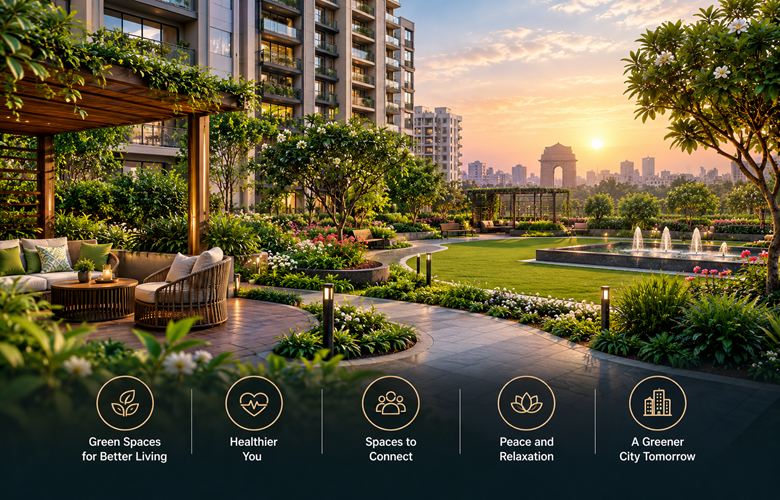
How Landscaped Gardens Enhance Apartment Living in the Heart of Delhi
Landscaped gardens in apartments make daily life cooler, calmer and more active. This Delhi Buyer Guide 2026 explains how green spaces can improve residential comfort. A citywide study found that increasing neighbourhood green cover from 3% to 11% lowered perceived heat by about 1°C. Views of trees are also linked to reduced stress and faster recovery from illness. For North Delhi homebuyers, key checks include actual planted areas, shade cover, planting on natural ground and public parks within walking distance, rather than relying solely on brochure open-space figures.
Green Spaces and Mental Health in Apartment Living
The best-known evidence on green views comes from a hospital in Pennsylvania. A 1984 study compared 46 surgery patients matched 2 by 2: one patient in each set had a window facing trees, the other faced a brick wall. The tree-view group stayed 7.96 days on average versus 8.70 days, drew 1.13 negative nurses’ notes per patient versus 3.96, and needed fewer moderate and strong painkillers.
For apartment buyers, the key lesson is orientation, as your living room and main balcony shape your everyday view. A home facing mature trees offers lasting greenery at no running cost, while a view of a parking ramp or neighbouring tower is difficult to change. As part of the Delhi Buyer Guide 2026, check the tower position and unit outlook on the landscape layout before choosing your floor.
How Green Cover Reduces Heat in Delhi Homes
A Delhi working paper on neighbourhood heat surveyed 2,368 households across all 70 assembly constituencies and matched their answers with satellite data. Raising built-up surfaces in an area from 25 percent to 55 percent increased residents’ perceived heat by about 0.6°C, and every 3°C rise was linked to 5 to 6 percentage points more sleep disruption and a 15 percentage point rise in reported illness. As felt heat rose, the share of households reporting a decline in mental state doubled from 15 percent to 30 percent.
A review of urban greening research found parks about 1.15°C cooler than nearby built-up areas at night, slightly more than the 0.97°C gap during the day. Brick, concrete and asphalt store heat through the day and release it after sunset, which is why planting close to the towers matters most after dark.
A lawn in full sun looks green in photographs but provides little shade; leaf cover over walking tracks, seating, and play zones provides relief.
Open Area vs Green Area in Residential Projects
Brochures often quote an open area percentage. That figure covers every part of the site not under a building, including internal roads, fire tender paths, surface parking, paved plazas and drop-off points. Green area, soil planted with grass, shrubs, and trees, is only part of it.
Delhi now writes minimum planting into planning law. Under the Master Plan for Delhi 2047, in force since 20 August 2026, residential plots in Low Density Areas must keep at least 50 percent of total plot area as green area, with at least 30 percent under tree canopy. Plots in the High Density Corridor must develop at least 15 percent as green space.
These rules apply to specific plot types, so use them as a yardstick rather than a promise for every project. When you review an apartment plan, ask for 2 figures separately: the planted share of site area, and the area planned under trees.
Rainwater Harvesting and Garden Irrigation in Housing Societies
Delhi requires rainwater harvesting on plots larger than 100 sq m, so every housing society in the city must plan for monsoon runoff. Soft green ground helps that system work, because water can soak in through planted beds instead of racing to storm drains.
Irrigation decides whether a garden survives May and June. Ask whether the society will water its lawns and trees with treated water from its own sewage treatment plant, and whether drip lines are planned for shrubs and hedges.
Podium Garden vs Ground Level Garden
Many high-rise projects place their gardens on a podium, a concrete deck over the basement car park. Deck planting grows in planters or a shallow soil layer, which limits how large trees can grow and how much rainwater soaks in.
Gardens planted in natural earth at grade let trees root deeply, reach full canopy and absorb monsoon rain. A sound layout keeps large shade trees on natural ground and uses the deck for lawns, seating and play areas. Ask which landscaped zones in the approved plan are planted at grade.
3-30-300 Rule for Green Living
Introduced in 2021, the 3-30-300 rule is an urban forestry benchmark for healthy neighbourhoods. It asks for:
1. 3 trees visible from every home.
2. 30 percent tree canopy cover in every neighbourhood.
3. A public park or green space within 300 metres of every home.
You can test any project against it in one visit. Count the trees from the window of the unit you are considering, judge the leaf cover along the approach road, and time your walk to the nearest public park.
RERA Rules on Changes to Layout Plans and Common Areas
The garden shown in the sanctioned plan is protected by law. Under Section 14(2)(ii) of the Real Estate (Regulation and Development) Act, 2016, a promoter cannot alter sanctioned plans, layout plans or common areas without the prior written consent of at least two-thirds of allottees, with each allottee counted once, however many units they book.
Keep the sanctioned layout plan with your agreement papers. If the landscaped area on site starts to differ from it, that document is the basis of a complaint to the state RERA authority.
Landscaping for Children and Senior Citizens in Apartments
Green spaces in residential societies serve each generation differently. Children need a play area that parents can see from the lobby or lower floors, with soft flooring and shade from trees rather than only a fabric canopy. Older residents need a level walking loop with no steps, a firm surface that stays dry after rain, and benches at short intervals under shade.
Lighting decides whether these spaces work in the evening, since the sun sets around 5:30 pm in Delhi in December. Check where path lights are drawn on the layout, not only where the lawns are.
Parks Near Kamla Nagar North Delhi
When we map Kamla Nagar for buyers, one pattern stands out: older houses here have little private green, yet 2 large public green spaces lie close by.
Roshanara Bagh, on Roshanara Road in Shakti Nagar, is a Mughal-style garden laid out by Roshanara Begum, daughter of Shah Jahan. It is near the Kamla Nagar Clock Tower and the North Campus of Delhi University.
The Northern Ridge, locally called Kamla Nehru Ridge, is a forested part of the Aravalli range beside the university. In October 2026, the Delhi government approved 277.56 acres of this Ridge as reserved forest under Section 20 of the Indian Forest Act, 1927.
For a household in this area, the society garden covers daily use: a morning walk, a child’s play hour, an evening on a bench. The Ridge and Roshanara Bagh serve longer weekend outings.
“Judge a garden by its shade at 4 pm in June, not by its photo in the brochure.”
New Apartments in Kamla Nagar North Delhi
On the former Birla Cotton Mills land, a 10-acre site in Kamla Nagar that Texmaco has owned for more than 100 years, Texmaco of the Adventz Group, Hines, Conscient Infrastructure and HDFC Capital are developing about 30 lakh sq ft of homes and retail. The residences, known as Conscient Elevate Kamla Nagar, mark Hines’ entry into Delhi’s residential market.
Buyers who search for Elevate Kamla Nagar can apply each check in this guide once the landscape plan is released. Updates on Conscient Elevate Delhi are posted on where you can also request floor plans as soon as they are out.
Frequently Asked Questions About Garden Living in Apartments
What are the benefits of landscaped gardens in apartments?
You get safe outdoor space inside the complex where children can play, and older family members can walk without crossing busy roads. Shared lawns and paths give neighbours a natural place to meet, which helps the residents’ association work better. A planted boundary also screens lower-floor homes from street views and gives them more privacy.
Does landscaping increase property value in India?
No published figure shows a fixed price gain for Delhi apartments with better gardens, so treat any quoted percentage with care. In practice, a garden helps at resale when it is mature and well kept, because buyers judge it in person. Before you book, ask how irrigation and the gardening contract will be funded after handover.
Which trees are best for apartment gardens in Delhi?
Choose native, drought-tolerant trees that give dense summer shade. Neem, jamun, amaltas and arjun suit Delhi’s climate and attract birds. Ornamental palms look neat in brochures but give you little shade and need more water in the dry months, so check the plant list in the landscape plan before you decide on a project.
Who maintains the garden in a housing society?
Before handover, the developer or its facility manager usually runs the garden. After that, the residents’ association takes charge and pays for it through monthly maintenance. You should ask for the estimated charge, whether gardening will be outsourced, and whether the gardening budget is shown as a separate line in the maintenance estimate.
Is a balcony garden enough in an apartment?
A balcony garden helps, but it cannot replace shared green. Planters give you herbs, colour, and a little shade, yet they hold too little soil for shade trees and add weight to the slab, so check the load limit with your society first. Use the balcony for daily greenery and the complex garden for walking and play.
How can you judge a garden during a site visit?
Visit in the afternoon, not only in the morning, so you see where shade actually falls and how hot the paths get. Check drainage after rain, the health of young trees, and the lighting along walking tracks. If the project is still under construction, ask to see the full landscape drawing with the plant list.
What is the Northern Ridge Biodiversity Park?
It is a nature park on the Ridge close to Delhi University, developed and maintained by the Delhi Development Authority. For Kamla Nagar residents, it is one of the closest large green stretches for long walks. You can see how it relates to the project location in our Kamla Nagar locality.
