
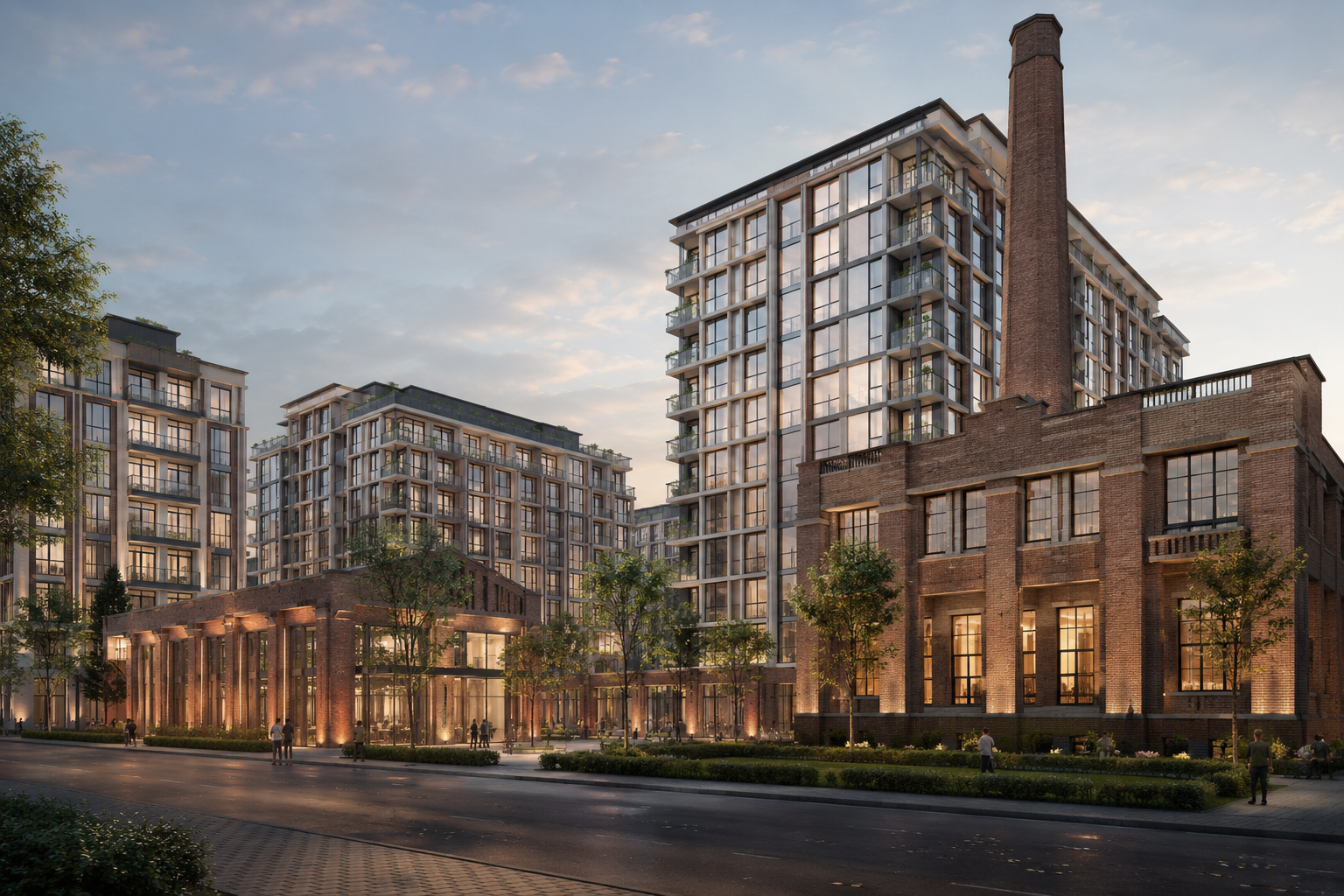
How the Birla Cotton Mills Redevelopment Could Change North Delhi Forever?
Ten acres of land in Kamla Nagar, held by the same family business for more than a century, are about to do something North Delhi has not seen in three decades: produce a 3-million-square-foot luxury high-rise inside the old city. The site of the former Birla Cotton Mills, whose factory whistle once set the rhythm of daily life in this stretch of Delhi’s north, has been put into a redevelopment consortium that includes Texmaco Infrastructure & Holdings of the Adventz Group, US-based Hines, HDFC Capital, and Delhi-NCR developer Conscient Infrastructure. The reported gross development value is roughly ₹9,000 crores, against an estimated build-out cost of ₹4,000 crores.
That is, on its own, a large number. But the number is not what makes the project significant. What makes it significant is that, for the first time in a generation, a serious institutional consortium has decided that the part of Delhi north of Connaught Place can support a luxury residential price point – and is willing to put close to a billion dollars of capital behind that bet.
A neighbourhood that the luxury market forgot
Kamla Nagar’s history runs against the grain of how Delhi’s premium residential market has evolved. The neighbourhood rose to prominence after the Ram Swarup Clock Tower came up on the Grand Trunk Road in 1941, and the establishment of the Jaipuria and Birla textile mills that followed. By the 1950s, it was an affluent address. It sat next door to Delhi University’s North Campus, anchored a thriving retail market, and was home to some of the city’s most established trading and professional families.
For the past thirty-odd years, however, almost all of Delhi-NCR’s new luxury supply has moved south or south-west – to the Lutyens-adjacent colonies, Vasant Kunj, Jor Bagh, and from there outward into Gurugram’s Golf Course Road and Dwarka Expressway corridors. North Delhi’s HNI residents, broadly speaking, have had two choices: stay in an ageing bungalow stock with no real high-rise alternative, or relocate to a part of the city where the brand of luxury they wanted actually existed. Most chose to stay. The result was a generation of pent-up demand in a neighbourhood that was, on every other parameter, ready for a premium product.
The Birla Mills redevelopment is the first project of consequence to test whether that demand is real or just assumed.
What the consortium is actually doing
The project’s specifics, drawn from the joint statement issued by the developer consortium and subsequent filings, are unusually clear for an Indian launch this early in its cycle. The 10-acre parcel will carry seven standalone towers – built without shared podiums or shared walls, which is itself a structural choice that telegraphs the price band – at roughly G+50 floors each. Six of the towers are planned as 3 BHK plus servant room configurations in the 2,600-2,800 sq. ft. range, with four units per floor. A seventh, dedicated tower will house 3,500 sq. ft. four-bedroom residences at two units per floor.
Reported launch pricing sits at approximately ₹28,000 per sq. ft., which translates to ₹7.5-8 crore for the 3 BHK and ₹10-11 crore for the 4 BHK. Around 400,000 sq. ft. of the total footprint is earmarked for Grade-A retail, which is what makes the project legally a mixed-use rather than a pure residential redevelopment. RERA registration is reported as applied, with a receipt expected around June 2026. Possession timelines have not been firmly published.
Two facts about the partnership matter more than the unit specs. The first is that Hines, the Houston-headquartered firm best known internationally for Hudson Yards in New York and One Blackfriars in London, is making its first Delhi residential investment here. Global capital does not enter a new metro through its safest postcode; it enters through the project where the brand and balance-sheet risk are best matched to the upside. The second is that Conscient Infrastructure, the Delhi-NCR partner in the consortium, is the local market-knowledge piece – and the company has placed the Birla Mills project, marketed as Conscient Hines Elevate, as the centrepiece of its current Delhi portfolio. That alignment of a global capital partner, a domestic financial partner (HDFC Capital), a century-old landowner, and a local developer is the kind of structure that JLL India and Knight Frank reports have repeatedly flagged as the new template for large urban redevelopment in India.
What “change North Delhi forever” actually means
There are roughly four ways a project of this scale rewires a neighbourhood. The Birla Mills redevelopment plausibly does all four.
Comparable pricing benchmarks. Before this launch, North Delhi had no genuine peer to anchor luxury pricing. Resale stock in Civil Lines and the older Conscient Hines Kamla Nagar bungalow belt traded on bilateral negotiation, not on a published rate card. A ₹28,000 per sq. ft. new-build benchmark – sustained or not – gives every existing property in a two-kilometre radius a reference price for the first time in years. This is the same mechanic that repriced Worli after Lodha World One, and that repriced parts of Gurugram’s Golf Course Road after the DLF Camellias launch in 2014.
Retail and F&B follow capital. The 400,000 sq. ft. of Grade-A retail is not incidental to the residential strategy. Anchor tenants in Indian luxury developments – the H&Ms, Apples, and Zaras of the category sign leases against a captive HNI footfall projection. If the consortium can land a credible anchor mix, the retail upgrade itself becomes a price-supporting factor for the residential. If it cannot, the retail component becomes the project’s largest single risk, given post-COVID Grade-A occupancy in Delhi has hovered in the 70-75% range against pre-COVID levels of 85-90%.
Infrastructure pressure. Three million square feet of new construction inside an already dense old Delhi grid puts real pressure on water, sewerage, and last-mile road access. Kashmere Gate metro is approximately 8 km away; DU North Campus is 3 km. The consortium has not publicly detailed its civic infrastructure contribution, and the relevant primary source for any buyer doing diligence here is the project’s HARERA filing once it is registered, plus the MCD’s clearance trail.
Demographic anchoring. This is the change that matters most and is hardest to measure on a spreadsheet. North Delhi’s old-money families have, for a generation, watched their grown children leave for Gurugram apartments because the inventory simply was not here. A 600-to-700-unit luxury supply, if absorbed at planned pricing, retains a meaningful slice of that demographic inside its parent neighbourhood. The cultural and commercial spillovers from those restaurants, schools, and professional services are what would actually “change North Delhi forever,” and they would take five to seven years to fully read.
“What is unusual about Conscient Hines Kamla Nagar is not that a luxury project is coming. It is that this is the first time a fully institutional consortium, a global developer, a domestic financial partner, and a hundred-year landowner, has agreed that the geography supports a ₹7-crore-plus ticket. If the launch absorbs at planned pricing, every other large Old-Delhi land parcel becomes a redevelopment conversation. If it does not, the conversation goes back into the freezer for another decade.” Vansh Bhutani, Real Estate Investment Strategist, HCO Real Estates
The case against getting carried away
It is worth saying clearly that this is a 2031-handover project at a price point North Delhi has never tested. Three risks deserve attention.
The first is the comparable-set problem. The closest reference launches for a Delhi luxury high-rise this scale are DLF One Midtown (2022) in Moti Nagar and the TARC Kailasa project on Patel Road, both of which launched at ₹20,000-₹25,000 per sq. ft. Conscient Hines Elevate Delhi is launching roughly 10-15% above that band, which the consortium is justifying largely on the strength of the Hines brand and the Kamla Nagar postal address. Whether the brand premium holds through 2027-2028 absorption is, on most analyst readings, the single biggest open question on the project.
The second is the macro absorption picture. Anarock’s annual review for 2025 reported a ₹2.5 crore-plus segment that accounted for more than 21% of new national supply – a structural premiumisation story that has held up well – but also flagged Delhi-NCR’s 8% YoY volume decline in 2025 against a backdrop of IT-sector layoffs and tariff tensions. Knight Frank India’s market reading for the year similarly noted that homes above ₹1 crore now account for roughly half of all sales across the top eight cities, but warned that demand is becoming increasingly differentiated by ticket size. Luxury is holding up; it is not impervious.
The third is delivery and compliance. Long-cycle redevelopment of an industrial parcel inside an old-city grid involves environmental clearances, demolition logistics, and civic-utility upgrades that are not in the consortium’s direct control. The HARERA registration, once received, is the right primary source for buyers tracking project-level compliance, and it should be checked tower-by-tower rather than at the parent-project level. The mill’s industrial-land conversion approvals are a separate trail and equally relevant.
What to watch over the next 18 months?
There is a version of the next two years in which the Birla Mills redevelopment becomes the project that pulls North Delhi Conscient Hines Kamla Nagar, back onto the luxury map, drags retail and F&B upgrades along with it, and triggers conversations on every other large old-mill and old-industrial parcel in the city. There is another version in which the pricing proves too ambitious, absorption stretches to 30 or 36 months, and the project becomes a cautionary footnote in the next ANAROCK report.
The three signals that will discriminate between those two outcomes are reasonably specific. First, the absorption rate in the first six months after public launch – anything inside 40-50% of Phase 1 inventory at sticker price would, in this market, count as a clean validation. Second, the retail anchor list – a credible Apple, Zara or H&M signing would compress the project’s largest single risk. Third, the HARERA filing and possession-stage compliance pattern through 2026-27, because a project of this scale cannot afford to telegraph any delivery uncertainty in its early years.
Conscient Hines Kamla Nagar has been waiting a long time for the rest of Delhi’s luxury market to notice it was still there. The Birla Mills consortium has made the most expensive bet ever placed on that proposition. Whether the bet pays will be visible by mid-2027, at the latest. Until then, the most useful thing a serious buyer or observer can do is read the HARERA filings as they appear and watch the absorption.
The mill is gone. What replaces it will define the neighbourhood for the next thirty years.
